


 EN
EN DE
DE CH
CH AT
AT
Pay Bands 2026/2027: How to Build a Fair Salary Matrix – Before It Becomes Mandatory
 Lisa Puls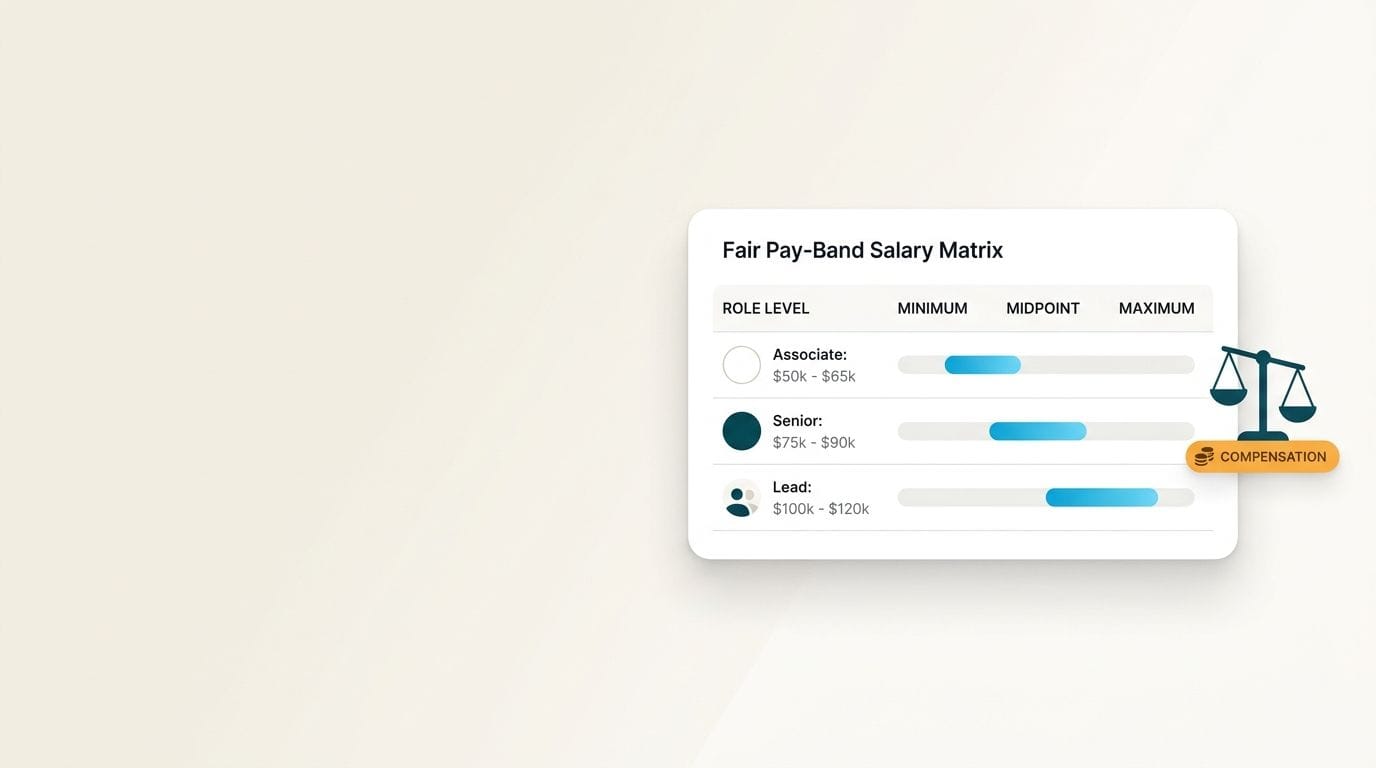
The EU Pay Transparency Directive forces companies to structure pay according to objective, gender-neutral criteria – and that's exactly what pay bands are for. The good news: in Germany, the timeline is slipping. That's not a reason to relax; it's your best opportunity. Whoever builds their salary matrix now avoids a scramble under deadline pressure later. This guide walks you through it, step by step.
Why the window right now is so valuable
Technically, the EU Pay Transparency Directive (2023/970) was meant to be transposed into German law by 7 June 2026. But that's not how things are shaping up: the national implementing law is now expected to take effect only in early 2027, with the new information and reporting obligations likely applying to private employers from June 2028. For public-sector employers, by contrast, the directive already applies directly.
Sounds relaxed? It isn't. Overhauling a pay structure is not a one-quarter project. Taking stock, building the job architecture, defining the evaluation logic, benchmarking, slotting in existing salaries and – the trickiest part – correcting outliers typically stretch over months, often more than a year. Companies that only react shortly before the deadline risk not just organizational chaos, but expensive rework and legal exposure.
The delayed timeline is therefore not a reason to wait, but the argument to start now – without deadline stress and with the room to still fix mistakes before they become visible in a report.
What the law actually requires (and why it leads to pay bands)
The directive doesn't literally prescribe pay bands. It requires something that's hard to satisfy cleanly without them: pay decisions must rest on objective, gender-neutral criteria and be comprehensible to employees.
Concretely, the directive names four core criteria for evaluating work of equal value:
- Skills (qualifications, competencies, education)
- Responsibility (people, budget, outcome responsibility)
- Effort (the demands and strain of the role)
- Working conditions (the circumstances under which the work is done)
For pay progression, individual performance, competence development and seniority are added. Anyone who has so far handed out salaries informally, by market feel or by negotiating skill, needs to rethink – not least because Germany's Federal Labor Court has already made clear that stronger negotiating is not an objective criterion for paying a female colleague less for the same work.
On top of that comes the reversal of the burden of proof: if you fail to meet your transparency obligations and someone complains about unequal pay, it will be you who has to prove the difference is objectively justified. A documented salary matrix is therefore not just an organizational tool, but your most important safeguard in a dispute.
Building your salary matrix in 8 steps
1. Take stock: where do you stand?
Before you structure anything, you need an honest picture. Pull together all relevant pay data – and that means total compensation, not just base salary: bonuses, variable components, allowances, benefits in kind, perks. Break this data down by gender, function and department. This very analysis will later become the basis for your gender pay gap report.
A quick self-check: are there comprehensible ranges for comparable positions? Are roles evaluated against objective criteria? Are pay decisions documented and justifiable? The more often you answer "no," the greater the need to act.
2. Build the job architecture: define functions and levels
A salary matrix needs a grid. Group similar roles into job families (e.g. Engineering, Sales, HR, Finance) and define career levels per family (e.g. Junior, Professional, Senior, Lead). Each combination of job family and level later forms a cell in your matrix.
What matters here is the principle of work of equal value: two roles don't have to be identical to be comparable. Clear job profiles and requirement levels help you map them cleanly.
3. Define objective evaluation criteria
Now you anchor the four legal criteria – skills, responsibility, effort, working conditions – as the evaluation logic behind your levels. For each level, define which requirements must be met. This makes it traceable why a role sits at Level 3 and not Level 2. You may add further criteria and set the weighting yourself – what's decisive is that the logic is documented in writing and communicated internally.
4. Bring in market data
Internal logic alone isn't enough – your bands also have to be competitive. Pull in benchmark data for your roles and regions (salary reports, industry associations, specialized providers). This anchors every matrix cell in a realistic market level, rather than in salaries that grew by chance.
5. Define the bands: minimum, midpoint, maximum
For each cell you set a range, usually across three points:
- Minimum: entry into the level, still ramping up
- Midpoint: fully ramped, delivers the role solidly (often aligned to the market median)
- Maximum: top performers or long-standing expertise
Two levers are decisive: the band width (how far minimum and maximum sit apart, often 20–40%) and the overlap between adjacent levels. Some overlap is healthy – it means an experienced Professional doesn't immediately block a Junior's next step. Too much overlap, however, makes the levels meaningless.
6. Slot in existing salaries – and surface the outliers
Now you lay your real workforce over the matrix. Two cases almost always appear:
- Above the band: the salary sits above the cell's maximum. Usually don't cut it, but "freeze" it until the band catches up.
- Below the band: the salary sits below the minimum. Here you have genuine work to do – and this is exactly where the unintended gender gaps often hide.
This step is uncomfortable, but it's the real point of the exercise. Because if the adjusted gender pay gap in a category is 5% or more and can't be objectively justified, a joint pay assessment with the employee representatives becomes mandatory. Whoever finds the outliers now corrects them quietly – rather than later, under scrutiny.
7. Document and communicate
A matrix nobody knows about doesn't satisfy the directive. Record your evaluation criteria, bands and mapping logic in writing. Prepare response templates for information requests – employees will be entitled to ask for their individual pay and the average figures for their comparison group, and you'll have to respond within a set deadline. Also review job ads (the salary range belongs in them) and employment contracts for unenforceable confidentiality clauses.
8. Maintain it: the matrix is not a one-off project
Markets, roles and laws move. Plan fixed review cycles (at least annually) in which you refresh market data, adjust bands and slot in new roles. That keeps the matrix robust – and your later report becomes a by-product, not an ordeal.
The most common mistakes
- Too many, too narrow bands. Building a separate level for every nuance means you'll never be able to maintain the structure. Fewer, clearly delineated levels are more durable.
- Looking only at base salary. The directive means total compensation, including bonuses and benefits. Ignore the variable components and you overlook gaps exactly where they hide.
- Keeping the matrix quiet. Without communication and documentation, the legal protection is missing – and the internal trust never materializes.
- Data chaos. If pay data lives in Excel islands and email threads, every analysis becomes detective work. A single source of data is the prerequisite for everything else.
From matrix to reporting: the technical foundation
The real effort of pay transparency lies less in the principle – almost everyone agrees on "equal pay for work of equal value" – than in the organizational and technical operation. You need a data foundation in which roles, levels, pay components and compensation histories are cleanly linked and can be analyzed by gender, function and department.
This is exactly where an HR platform built natively on Salesforce plays to its strength: pay bands, function levels and the full compensation history live in one data source instead of scattered spreadsheets. Reports on the pay gap become a repeatable query – not a manual annual project. And because information requests and band maintenance run on the same data, your documentation stays consistent and robust in a dispute.
If you're rebuilding your pay structure anyway, it's worth thinking the data foundation through at the same time – rather than laboriously lifting a finished matrix into a system that wasn't built for it later. You can see how flair supports a structured, data-driven salary round here: Plan and manage your salary round efficiently with flair.
Conclusion
Germany's delayed timeline is no reason to sit back – it's the rare gift of lead time. A fair, documented salary matrix doesn't appear overnight, but it's the foundation for just about everything the Pay Transparency Directive demands: comprehensible criteria, clean disclosures, robust reports and protection against the reversed burden of proof. Those who start now shape the outcome – those who wait merely react.
This article offers practical orientation and is not legal advice. For binding guidance on implementing the Pay Transparency Directive, we recommend a law firm specializing in employment law. The status of the German implementing legislation is not yet final at the time of writing; deadlines may shift.

Related Articles

EU AI Act in HR: Which AI tools are allowed – and which are not?
Can ChatGPT be used in recruiting? Are AI candidate rankings still allowed? Here's what the EU AI Act really means for HR — which AI tools stay permitted, and which become high-risk.

Public Holidays in Australia 2027: Key Dates for HR Teams
For HR professionals in Australia, here's our guide to the 2027 public holidays in every state and territory, including the extra days for Anzac Day and Christmas.


Public Holidays Germany 2027
All statutory public holidays in Germany for 2027, where they apply and how to get the longest stretches off with the fewest vacation days – incl. a PDF calendar.