

 EN
EN DE
DE CH
CH AT
AT
Rest periods and sick leave, handled for you
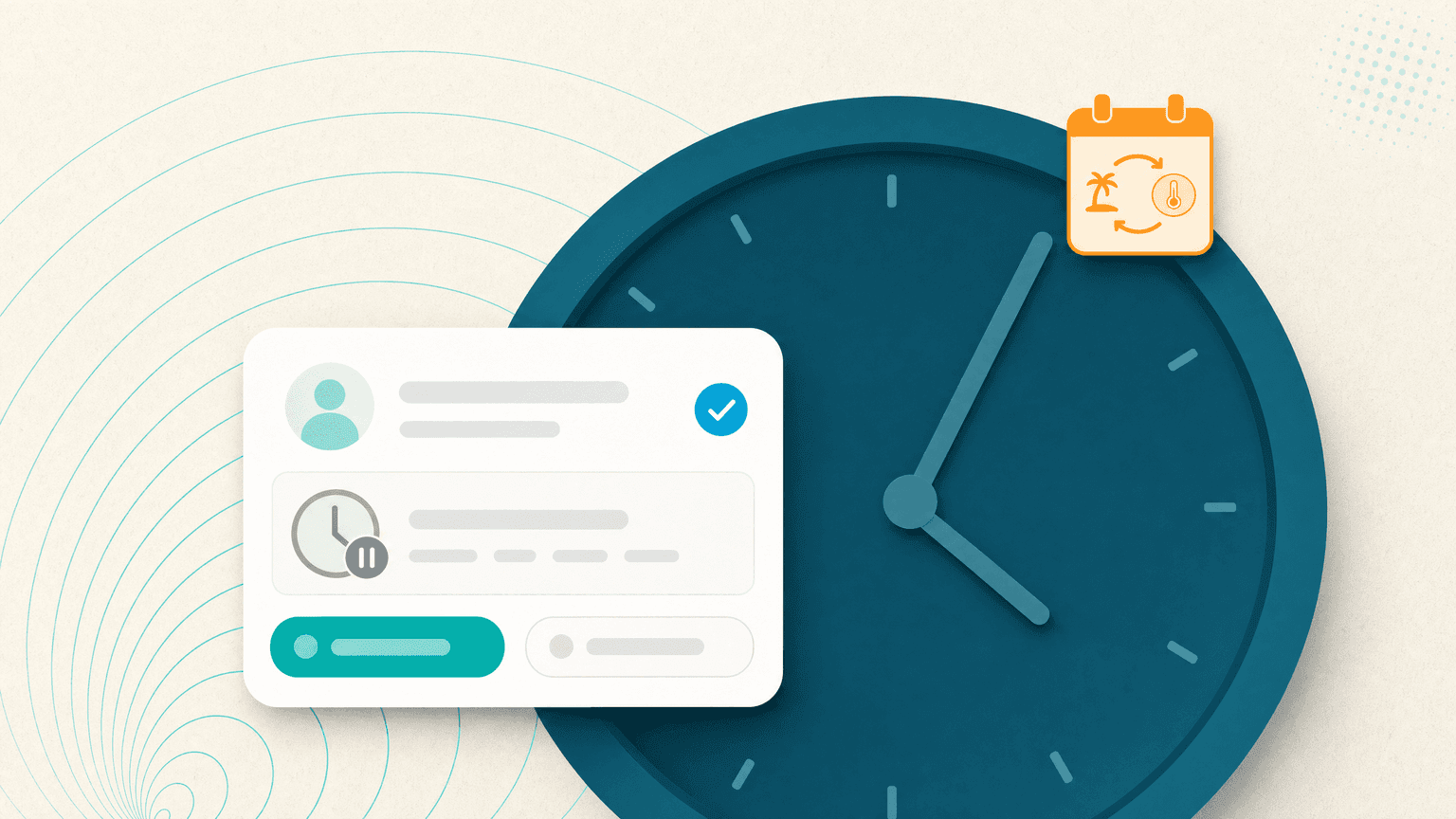
Two long-standing manual jobs are now flair's problem rather than yours. You can require a minimum rest period before an employee is allowed to clock in again — a number of continuous rest hours since their last clock-out, and/or one longer continuous break within a rolling window, configured per Time Framework. If someone tries to start too early, the clock-in is blocked and they're told exactly how much more rest is required, so the rule is enforced at the moment it matters instead of being caught in a payroll review weeks later. Alongside it, absence categories can now allow overlapping absences: when an employee falls ill during their vacation, the sick leave is requested over the top and, on approval, the vacation is ended automatically and the days go back where they belong. Until now that conversion — a legal requirement in Germany and across the DACH region — meant emailing HR and editing records in Salesforce by hand.
Key highlights:
- Require a minimum number of continuous rest hours since the last clock-out, per Time Framework
- Optionally require one longer continuous break within a rolling window, for weekly rest rules
- Early clock-ins are blocked with a clear message saying how much more rest is needed
- Sick leave can now be requested over an approved vacation, which ends the vacation and returns the days automatically
Learn more about rest periods →
More Improvements This Month
A skills catalog that organises itself
Your skills catalog stops being a flat list. Skills can now be grouped into categories — soft skill, hard skill, language, certification, or anything you define — and employees can carry months and years of experience per skill. Managers and HR see a Similar people card on an employee's profile showing colleagues with overlapping skill profiles, with match percentage and shared skills, which makes internal mobility, pairing and rotation decisions something you can actually look up. Project leads can attach required skills to a project so staffing is driven by capability, and admins can now lock individual skills against self-editing — useful when a skill like first-aider certification drives shift planning and an accidental self-edit breaks the schedule. Learn more about skills →
Record where the work happened, on the time entry
Time entries now take custom form fields, so employees can capture the context that matters to you — home office or onsite, for example — as they create an entry. The fields can be filled in on past entries too, managers see them in the time entry controlling views, and fields you mark as required are now genuinely enforced at clock-out rather than needing a hand-written validation rule to back them up. Learn more about extra form fields →
Set up a country's public holidays in one step
Building public holiday calendars region by region is over. HR admins can now create calendars for every state or region of a country in a single guided step — all sixteen German states at once, for instance — with the holidays filled in automatically and any calendar that already exists left alone. Learn more about absence policies →
Compensation reviews in every currency, against a real budget
Compensation reviews now work properly for organisations that pay in more than one currency: each salary appears in its own currency with an approximate conversion alongside it, review totals are calculated in yours, and pay-band guidance adjusts to match each salary's currency and pay frequency. Reviews also gained a budget dimension — a Budgets tab where you allocate the budget behind a review, and a consumption view showing how much of it a review has used as managers work through their teams. If you use a single currency, nothing changes. Learn more about Compensation Review →
Choose the filters on your careers page
Your public job listing no longer has to show the same three fixed filters. Pick any job field to filter on — department, location, employment type or one of your own — give each filter a label that matches your tone, reorder them, or drop them entirely. The text above the optional questions on the application form is now yours to write as well. Learn more about career portals →
Share a scheduler with just the team that needs it
Schedulers now support visibility rules and segmentation, so a shift schedule can be shared with a specific department, location or team instead of everyone who can open shift planning. Predefined shifts can also run a full 24 hours now, up from a ceiling of 23 hours and 59 minutes.
Your kiosk pass, on your phone
Employees who clock in at a shared kiosk device can now pull up their kiosk pass in the flair mobile app — their PIN as a legible number and as a scannable QR code, working offline. The PIN is still managed on your side in Salesforce; the app only displays it, and the section stays hidden for anyone who doesn't have one. Project time tracking and shift transfer requests arrived on mobile in the same release. Learn more about kiosk time tracking →
Smaller Updates & Fixes
- Absence Management: Allowance corrections now accept half-days and other decimal amounts, including comma decimal separators used in German and French locales.
- Absence Management: An absence can no longer be approved when the allowance doesn't cover it, so balances stop going negative.
- Absence Management: An hourly absence category can be set to count only scheduled working hours, so a request outside someone's working window no longer reduces their balance.
- Employee Hub: If you've renamed the Department or Location object in Salesforce, your name for it now appears in filters, columns, tabs and pickers across Attendance, Staff & Docs, Workplace, Inventory, the shift planner and reports.
- Employee Hub: Two new settings control profile pictures independently — one blocks employees from changing their own avatar, the other prevents avatars being deleted.
- Employee Hub: Each Hub of a Salesforce org can now be connected by its own integration user, and connection health is reported per Hub rather than per org.
- Employee Hub: The job list is no longer capped at the first 250 jobs, so organisations with several hundred open roles can see and search all of them.
- Onboarding: New hires can add certificates such as work permits during pre-onboarding, before their first day.
- Payroll: Employees can be assigned to multiple cost centers, each with its own allocation percentage and optional start and end dates.
- Payroll: Payroll run overtime is now calculated from the dates of the time entries rather than the dates of the payroll run — the pattern used across DACH, where payroll is processed the following month.
- Recruiting: Talent, Candidate and Employee records can be enriched from a LinkedIn profile, and cloning a job now carries over its Career Portal field overrides.
- Engagement Surveys: HR admins can see the participant list for anonymous surveys, without seeing any individual's answers.
- Approvals: The Approval Request Details panel now shows the change request reason, so approvers see the justification that was required of the requester.
- Help Desk: Ticket closure emails now name the ticket, and tickets accept several attachments at once.
- Position Management: Removing someone from a position now revokes their access to the data of that position's child positions straight away.
Questions about these updates? Contact our support team or check out our Knowledge Base.