


 EN
EN DE
DE CH
CH AT
AT
HR Trends for 2027: 8 Shifts HR Teams Should Plan For
 Rosalie Macmillan
HR is heading into 2027 with AI moving from pilot projects into everyday work, engagement at a multi-year low, and two EU laws (pay transparency and the AI Act) turning into concrete deadlines. Below are eight trends HR teams should plan for, each backed by a current report rather than a gut feeling.
We looked at the 2026 editions of the big HR studies: Gartner's CHRO priorities, SHRM's State of AI in HR, Microsoft's Work Trend Index, Deloitte's Global Human Capital Trends, Gallup's State of the Global Workplace, Mercer's Global Talent Trends and CIPD's Good Work Index, plus the World Economic Forum's Future of Jobs Report 2025 and the EU legal texts. Where a figure comes from a survey, we say who was asked.
HR Trends for 2027 at a Glance
- HR builds its own AI strategy
- AI agents arrive, and organisations lag behind their people
- Skills become the main constraint
- Engagement hits a low, and managers are the lever
- Pay transparency becomes law in the EU
- AI in hiring and people decisions becomes regulated
- Flexible work is settled; the four-day week stays niche
- AI literacy becomes an HR job
1. HR Builds Its Own AI Strategy
For 2026, Gartner surveyed 426 CHROs across 23 industries and named "Harness AI to revolutionize HR" the first of four top priorities. Gartner adds that evolving the HR operating model has the highest predicted impact on AI productivity gains, at 29%. The other three priorities are shaping work in the human-machine era, mobilising leaders for growth in an uncertain world, and addressing culture atrophy (Gartner).
In practice, many HR teams are still at the start. According to SHRM's State of AI in HR 2026 (more than 1,900 HR professionals), just 39% of organisations have implemented AI in their HR function, and another 7% plan to this year. 56% of HR functions don't formally measure the success of their AI investments, and only 16% use ROI as a metric. Where HR does use AI, it's mostly in recruiting (27%), HR technology (21%) and learning and development (17%).
What to do in 2027: pick a few HR processes with clear volume and rules (screening, onboarding, employee questions, reporting), define what success looks like before you start, and measure it. AI works best on clean, connected data, so a single HR system of record matters more than ever.
2. AI Agents Arrive, and Organisations Lag Behind Their People
AI is moving from chat assistants to agents that complete tasks. Microsoft's 2026 Work Trend Index (20,000 workers in 10 countries, including Germany, France, the Netherlands, Italy and the UK) reports that active agents in Microsoft 365 grew 15x year over year. But only 1 in 4 AI users say their leadership is clearly aligned on AI strategy.
Deloitte's 2026 Global Human Capital Trends points the same way: only 14% of surveyed leaders say they are adept at shaping the interactions between people and AI. And of the one third of leaders who let workers go because of AI, more than half (57%) now question that decision.
What to do in 2027: treat AI as a work design question, not just a tool rollout. Decide which tasks move to agents, who reviews their output, and how roles and job descriptions change as a result.
3. Skills Become the Main Constraint
The World Economic Forum's Future of Jobs Report 2025 (more than 1,000 employers representing over 14 million workers) expects 39% of workers' existing skill sets to be transformed or become outdated between 2025 and 2030. 63% of employers name skill gaps as the main barrier to transformation, and 85% plan to prioritise upskilling their workforce.
Mercer's Global Talent Trends 2026 adds that 65% of executives expect 11–30% of their workforce to be redeployed or reskilled. Deloitte found that 95% of executives are concerned about the accuracy of the data they have on candidates' skills and capabilities.
What to do in 2027: build a reliable picture of the skills you have before you plan the skills you need. A skills matrix tied to roles, reviews and learning makes internal mobility and skill-based hiring possible.
4. Engagement Hits a Low, and Managers Are the Lever
Gallup's State of the Global Workplace 2026 shows global employee engagement fell to 20% in 2025, its lowest level since 2020. Manager engagement dropped to 22%, down from 31% in 2022. Europe has the lowest engagement of any region, at 12%. Gallup estimates the cost of low engagement at $10 trillion in lost productivity.
CIPD's Good Work Index 2026 (UK, 5,074 workers) finds that line management, leadership, skills development and meaningful work have the biggest effect on business outcomes. Mercer reports that only 44% of employees say they are thriving at work, down from 66% in 2024.
What to do in 2027: invest in your managers first. Regular one-to-ones, clear goals and fair performance reviews give managers the structure to keep their teams engaged. Pair them with short engagement pulse surveys so you see problems early.
5. Pay Transparency Becomes Law in the EU
The EU Pay Transparency Directive (Directive (EU) 2023/970) had to be transposed into national law by 7 June 2026. Its core rules:
- Applicants must be told the initial pay or pay range before employment, and employers may not ask about their pay history (Art. 5).
- Employers with 250 or more workers report on their gender pay gap by 7 June 2027 and every year after that; employers with 150–249 workers by 7 June 2027 and every three years; employers with 100–149 workers by 7 June 2031 and every three years (Art. 9).
- An unexplained gender pay gap of at least 5% in a category of workers triggers a joint pay assessment with worker representatives (Art. 10).
Not every member state made the deadline. In Germany, for example, there was still no draft bill from the responsible ministry as of June 2026 (Orrick). The direction is clear, though, so check the status in each country you employ people in.
What to do in 2027: define pay bands and the objective criteria behind them, add ranges to job ads, and make sure your data can produce a pay gap analysis by category. Our pay transparency page shows how flair supports this.
6. AI in Hiring and People Decisions Becomes Regulated
Under the EU AI Act (Regulation (EU) 2024/1689), AI systems used for recruitment or selection (for example to target job ads, filter applications or evaluate candidates) and for decisions about promotion, termination, task allocation or performance monitoring are classed as high-risk (Annex III, point 4).
The obligations for these systems were originally due to apply from 2 August 2026. The Digital Omnibus on AI (Regulation (EU) 2026/1744) has moved that date to 2 December 2027 for Annex III systems. That gives HR teams roughly a year to get ready.
Employees are paying attention: Mercer reports that concern about losing one's job to AI rose from 28% in 2024 to 40% in 2026.
What to do in 2027: list every AI feature in your recruiting and HR tools, ask vendors how they will meet the high-risk requirements, and make sure a person reviews AI-supported decisions about people. Our guide to the EU AI Act in HR covers the details.
7. Flexible Work Is Settled; the Four-Day Week Stays Niche
The debate about returning to the office has given way to flexibility as standard. In the UK, CIPD's Good Work Index 2026 finds that 72% of employees use some form of flexible working arrangement, and formal homeworking has risen from 30% before the pandemic to 50% today.
The four-day week gets plenty of headlines but remains rare: 8% of workers in the CIPD survey use one, 14% have it available but don't use it, and 72% say it isn't available to them.
What to do in 2027: make flexibility fair and visible. Clear rules for remote days, flexible hours and part-time requests, plus reliable time tracking, keep flexible work compliant with working time law.
8. AI Literacy Becomes an HR Job
People are already using AI, often without help. According to CIPD, 34% of UK employees use generative AI in their role at least once a month, but two thirds of them have had no AI training at all, and 45% don't trust the output to be accurate.
The AI Act also expects providers and deployers of AI systems to take measures that support AI literacy among the staff who use them. That makes AI training a learning and development topic, not just an IT one.
What to do in 2027: set clear rules on which AI tools are allowed and for what, and build short, role-specific training into your learning programmes. Our article on generative AI in HR is a good starting point.
Get Ready for 2027 with flair
Most of these trends come back to the same foundation: clean, connected people data. AI agents need it, pay transparency reports depend on it, and skills and engagement programmes only work if they are built on it.
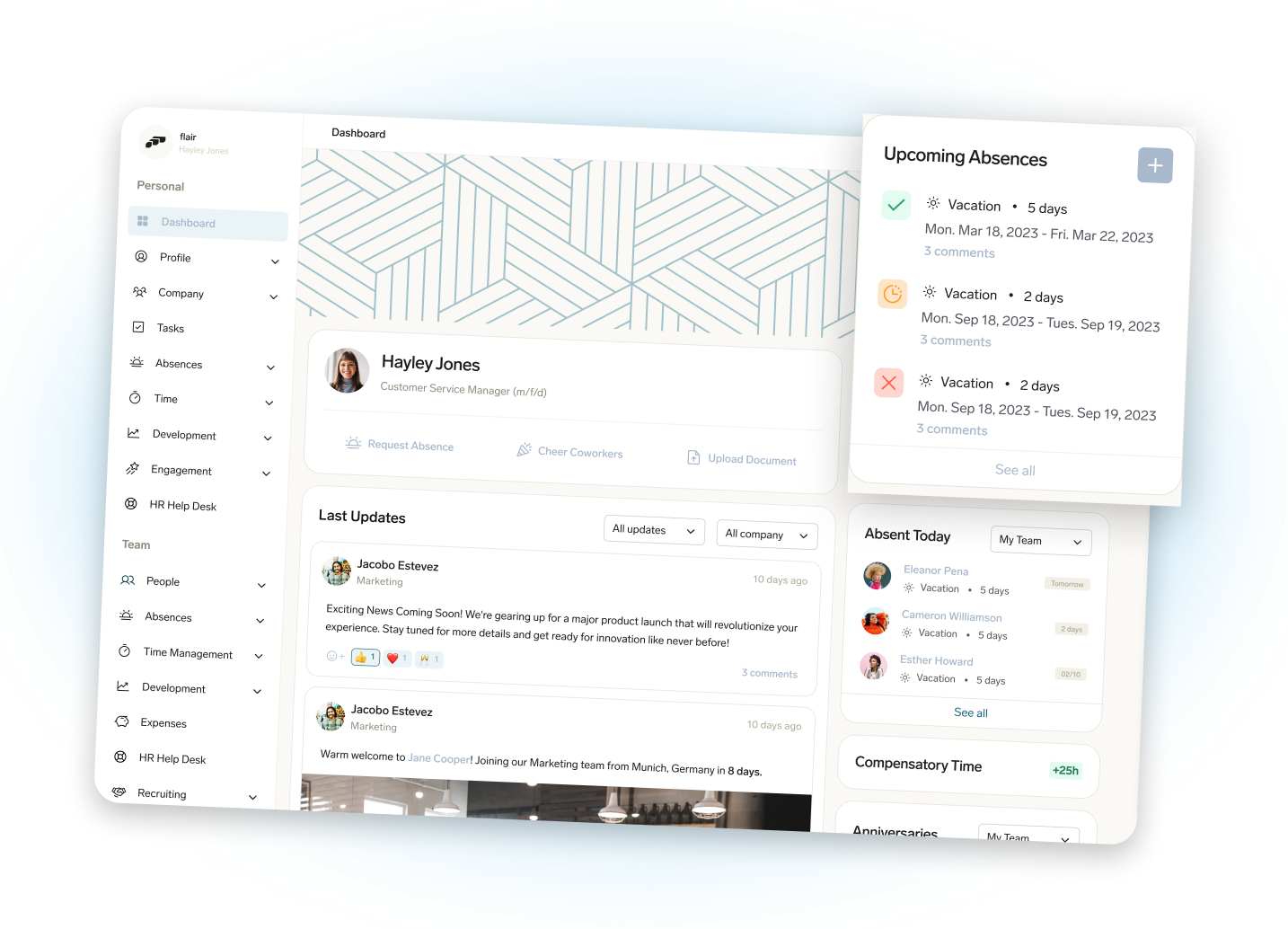
flair brings core HR, time tracking, absences, performance, skills and recruiting together in one platform, built natively on Salesforce. That gives you one source of truth for the people decisions 2027 will ask you to make, and the reports to back them up.
Ready for what's next in HR? Book a demo and see how flair can help.
Related Articles
Meet Salesforce Agentforce: The AI Platform You’ll Wish You Had Sooner
Agentforce is billed as the next big thing in the Salesforce ecosystem. Take a look at how the AI platform works and its potential use cases in HR and other business areas.


The Impact of Generative AI in HR: Trends and Use Cases
Explore the use cases, impact, and potential of generative AI in recruitment, onboarding, and performance management.

205 Startup Statistics: Trends, Rates, Funding, Cost, and Teams
Explore key startup statistics: success rates, funding trends, and industry insights. Get data-driven insights for your entrepreneurial journey.