
 EN
 DE
 CH
 AT
Minimum Wage & Minijob Threshold 2027: What HR Needs to Plan Now
 Lisa Puls
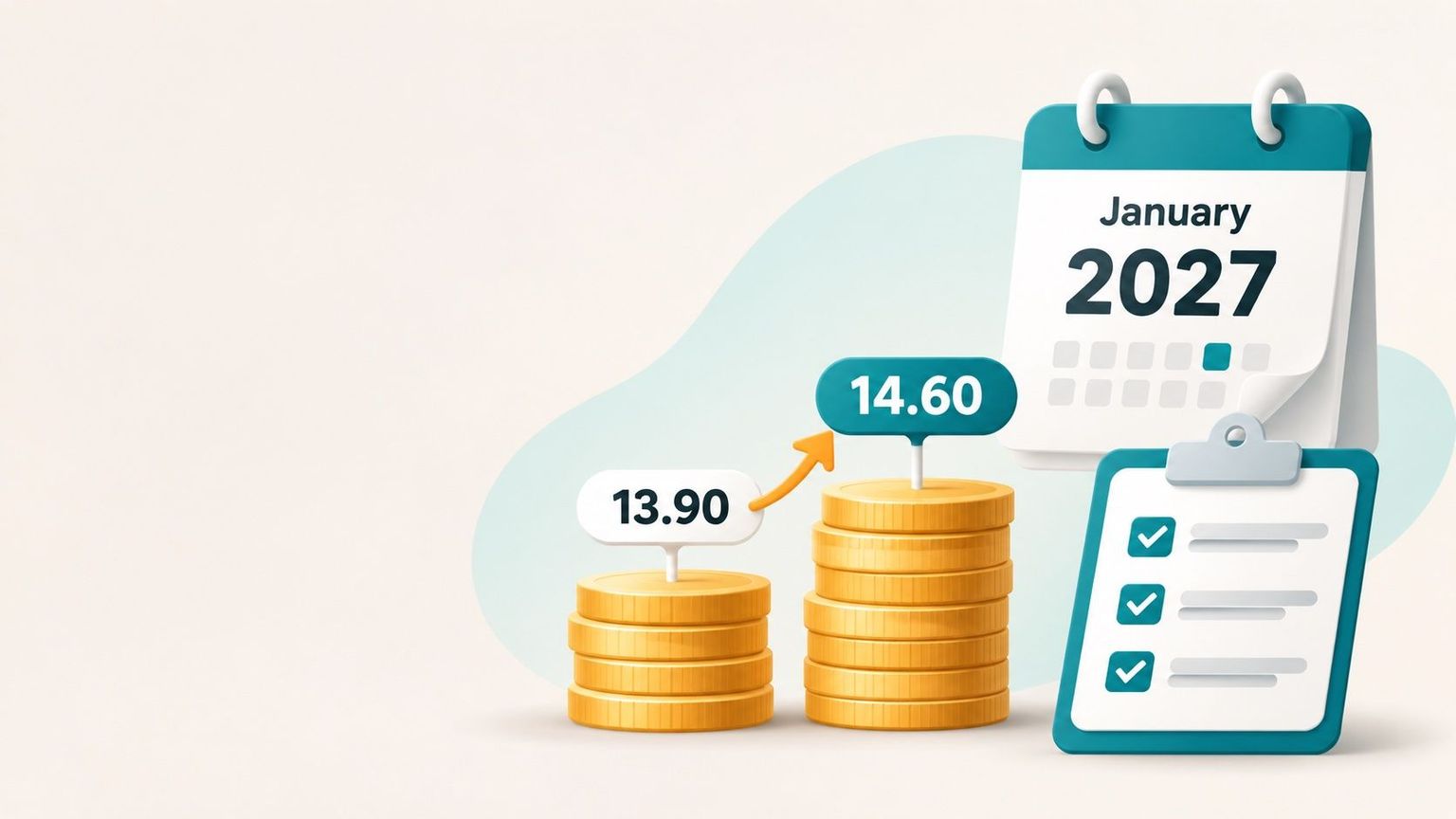
What changes on 1 January 2027
On 1 January 2027, Germany's statutory minimum wage rises from €13.90 to €14.60 gross per hour. This automatically raises the minijob threshold as well – from €603 to €633 a month.
Sounds like a quick adjustment? For HR and payroll it is a lot more: pay grades move closer together, minijob contracts need reviewing, and anyone who doesn't plan properly ends up fixing things in January under time pressure.
In this article you'll learn what changes, which employees are affected and what you should get done before the end of the year.
Minimum wage 2027: €14.60 per hour
The increase is confirmed: from 1 January 2027, the minimum wage is €14.60 – up from €13.90 in 2026. That is an increase of 70 cents, or around 5% per hour.
| Valid from | Minimum wage (gross/hour) | Minijob threshold (month) |
|---|---|---|
| 01/01/2026 | €13.90 | €603 |
| 01/01/2027 | €14.60 | €633 |
Who does it affect? All employees whose hourly wage is currently below €14.60 – full-time, part-time and minijob. Exceptions apply to certain groups, such as minors without completed vocational training.
The effect many underestimate: When the lowest pay grade rises, the gap to the grades above it shrinks. If you don't adjust your pay structure accordingly, you risk frustration among employees who were deliberately placed above the minimum wage. In companies with 500 to 5,000 employees, this quickly affects entire job families.
Does this also apply in Austria and Switzerland? No. Austria has no statutory minimum wage – pay is set by collective agreements. Instead of minijobs, Austria has marginal employment (geringfügige Beschäftigung), whose threshold remains unchanged at €551.10 a month in 2027. Switzerland has no national minimum wage; individual cantons such as Geneva, Basel-Stadt and Ticino set their own minimum wages.
Minijob threshold 2027: €633 per month
Since October 2022, the minijob threshold has been tied to the minimum wage. It is calculated with a fixed formula: ten hours a week at the minimum wage.
Minijob threshold = minimum wage × 130 ÷ 3 = €14.60 × 130 ÷ 3 = €632.67 ≈ €633
The annual threshold in 2027 is €7,596. From monthly earnings of €633.01, the midijob transition zone begins.
How many hours are possible in 2027?
| Hourly wage | Max. hours/month | Max. hours/week |
|---|---|---|
| €14.60 | approx. 43.3 | approx. 10.0 |
| €16.00 | approx. 39.5 | approx. 9.1 |
| €18.00 | approx. 35.1 | approx. 8.1 |
| €20.00 | approx. 31.6 | approx. 7.3 |
What matters in practice
- Annual forecast: What counts is regular earnings averaged over the year. Guaranteed one-off payments such as a Christmas bonus are included. Example: 12 × €620 + €240 Christmas bonus = €7,680 – above the threshold.
- Occasional overruns: In no more than two calendar months per year, the threshold may be exceeded unforeseeably, e.g. when covering for a colleague on short-term sick leave – up to double the amount, i.e. €1,266. Planned overtime does not count.
- Regular overruns: Anyone who earns more on a permanent basis is no longer a minijobber and becomes subject to social security contributions.
Checklist: What HR should do before year end
- Identify affected employees: Find everyone with an hourly wage below €14.60 – including part-time staff and minijobbers.
- Review pay grades: Assess the gaps between the lower grades and decide whether the structure moves up as well.
- Check minijob contracts: For fixed amounts just below €603, adjust hours or raise earnings to up to €633. Without an adjustment, the possible number of hours drops.
- Update annual forecasts: Factor in one-off payments and check whether €7,596 per year is maintained.
- Reclassify midijobs: Earnings just above €603 may fall back into the minijob range in 2027.
- Check hours: If you raise minijobbers' pay, check that planned hours × hourly wage still come to no more than €633 a month.
- Update the budget: Report the additional 2027 costs to Finance and Controlling.
- Communicate: Inform affected employees and managers in good time.
How flair HR supports you
Minimum wage adjustments work much like a compensation review – just with a statutory deadline. With flair HR, you plan them directly in your HR system instead of in scattered Excel sheets:
- Compensation reviews: Filter affected employees, simulate increases and keep the gaps between pay grades in view.
- Reporting & controlling: Analyse the additional costs for 2027 at the push of a button – for Finance and management.
- Compliance: Maintain minijob thresholds and contract data centrally so nothing slips through.
flair HR is Salesforce-native and built for companies with 500 to 5,000 employees.
Book a demo now – and approach your 2027 compensation review with ease. 🧡
FAQ
What is the minimum wage in 2027?
From 1 January 2027, the statutory minimum wage in Germany is €14.60 gross per hour (2026: €13.90).
What is the minijob threshold in 2027?
€633 a month, or €7,596 a year (2026: €603).
How many hours can a minijobber work in 2027?
At the minimum wage, around 43 hours a month or roughly 10 hours a week. With a higher hourly wage, correspondingly fewer.
Where does the midijob start in 2027?
From regular monthly earnings of €633.01.
What happens if a minijobber exceeds the threshold?
Occasional and unforeseeable overruns are allowed in up to two months per year, up to a maximum of €1,266 a month. Anyone who regularly earns more becomes subject to social security contributions.

Related Articles
EU AI Act in HR: Which AI tools are allowed – and which are not?
Can ChatGPT be used in recruiting? Are AI candidate rankings still allowed? Here's what the EU AI Act really means for HR — which AI tools stay permitted, and which become high-risk.
Public Holidays in Australia 2027: Key Dates for HR Teams
For HR professionals in Australia, here's our guide to the 2027 public holidays in every state and territory, including the extra days for Anzac Day and Christmas.


Public Holidays Germany 2027
All statutory public holidays in Germany for 2027, where they apply and how to get the longest stretches off with the fewest vacation days – incl. a PDF calendar.